Monday, August 5, 2013

Mystery Photo #21: Yes, indeed. Istanbul, Turkey.

     You guys are pretty good. I know some of you who got the right answers have not traveled extensively to this area of the world. Good job! Yes, indeed. The city is Istanbul, Turkey.
    
      Here is a map to orient you. One of you visualized the bodies of water around Istanbul quite well. Istanbul sits on an arm of water called the Bospourus.  The north end of the Bospourus originates in the Black Sea. To the city's immediate south is the Sea of Marmara. After crossing the Sea of Marmara in a boat, you would then cross through the Dardanelles and exit this narrow passage of water into the Mediterranean Sea. This map will help you visualize this watery city. Istanbul is located in the very northwest corner of Turkey where an arrow points to the Straits of Bosporous.


     The building in the first photo is called the Blue Mosque, named after the blue tile that lines its walls, and domes.

     The first photo in Mystery Photo #21 is the Sultan Ahmet Mosque, otherwise known as the Blue Mosque named after the Iznik blue tiles that line its interior walls. This Mosque was built from 1609 to 1616, under the reign of Sultan Ahmet  I. Its Kulleye (a group of buildings surrounding a mosque all of which are administered as one) contains the tomb of Sultan Ahmet I, a madrasah, and a hospice. The Mosque is active to this date, but it is also one of the main tourist attractions in the city of Istanbul along with the other building in my photos, the Hagia Sophia.

The façade of the Blue Mosque from its courtyard.
     The facade of the Blue Mosque is one of the last of the so called classical mosques built in the world. It is very similar to the Suleymaiye Mosque also in Istanbul. The adjoining courtyard is almost as large as the interior of the mosque, and is surrounded by a vaulted walkway on all sides, and has a place for ablutions on two sides. A central hexagonal domed fountain seems small in regards to the large court and to the mosque itself. A unique feature of the Blue Mosque is the presence of 6 minarets. When the Mosque was built however, it only had four minarets. Mosques generally obeyed an unwritten law and did not build more minarets than were present at the Sacred Mosque which surrounds the holy Kaaba in the city of Mecca, Saudi Arabia. In 1629, renovations to the Sacred Mosque were begun, and shortly thereafter 3 minarets were added to the already existing 4 minarets. Soon afterwards, the Blue Mosque attained two more minarets for a total of six.

The vaulted courtyard and one of the minarets.

The central fountain in the courtyard.
The domes in the ceiling. You can see why it is called the Blue Mosque
Some of the interior arches and domes, looking at the balcony.
It is indeed magnificent to just look up.
                       
Interior lighting is natural and then from strung light bulbs across the lower
 floor. At one time fancy shades covered these bulbs, including sea shells.
These have all been put into museums and artifact collections.

One of the large main pillars.
 
Islam forbids any images of Mohammad or other holy people. The name of
God, Mohamad and his teachings in the Quran can only be represented
by calligraphy.
 
A view of the Blue Mosque from the surrounding gardens. You can only see 4 of the minarets. The other two are to the right
behind the palm tree. You can see the classical symmetry of this style of mosque. Beautiful!
The apse of Hagia Sophia which here contains
the mihrab, that is the equivalent of an altar, set at an
angle in the apse so that when Moslems pray
facing it they are facing Mecca. Note the mosaic of
the Virgin Mary up in the half dome above.
     The second building viewed from our boat ride on the Bospouros was the Hagia Sophia. The name comes from the Greek which means "Holy Wisdom." The Church commemorates the Birth of the incarnation of the Logos in Christ, and represents the Wisdom of God. Sophia means wisdom in Greek. Hence the name Hagia Sophia.This magnificent domed church was constructed between 532 and 537 AD on the order of Byzantine Emperor Justinian, and was the third "Holy Wisdom" church to occupy this site, the previous two destroyed by rioters. It was designed by the Greek scientists, Isidore of Melitus, a physicist, and Anthemius of Trailes, a mathematician. Emperor Justinian had materials brought from all over the known world at that time. There were ancient columns from the Greek Temple of Artemis in Ephesus, porphyry stones from Egypt, large marble blocks from Thessaly, black stone from the Bospourus area, and yellow stone from Syria. Ten thousand people were employed in the building of this edifice.  It served as an Eastern Orthodox cathedral and the seat of the Patriarchate of Constantinople, except for a hiatus between 1204 and 1261 when it was converted to a Roman Catholic cathedral under the Latin Empire. It was the largest cathedral in the world until 1520 when the Cathedral of Seville was opened.

      In 1453, Constantinople was conquered by Ottoman Turks under Sultan Mehmed II. As most conquests were in those days, this one was brutal. The Sultan gave permission for his forces to ransack and loot for 48 hours before he would take over what was left. Many old, disabled, women and children took refuge in the church during the beginning of the conquest. When the Ottomans besieged the church and finally broke down the door, they slaughtered, raped, and/or enslaved all who were found within. It is said that the priests continued absolving people and doing their duties until the Ottomans physically stopped them. After 2 days Mehmed II ordered the Byzantine Church converted to a mosque. The Church itself had fallen into disrepair. At that time the 15 meter silver iconostasis, and other religious relics, and artifacts were removed. But most destructive was the painting over and plastering over of the ancient mosaics of the Virgin  Mary, Jesus, and the Apostles and Christian saints.

     Hagia Sophia has stood for almost 1500 years. But it has not been an easy existence. It has withstood many different earthquakes and with several of the major ones, large portions of the church were damaged. The main problem was this building's massive central dome. Another problem was that when the church was built, too much mortar was used in relation to the number of bricks. AND the mortar was not allowed to dry and cure properly. So when the dome was placed on the walls, its weight made the walls buckle outward. Over the years, earthquakes often shook this heavy dome and caused portions of it to collapse. On one occasion the leaning walls would not allow the dome to be reconstructed. So the walls had to be built up with another layer to support them and make them perpendicular to handle the weight of the dome. On another occasion of repair, buttresses were added externally to support the walls. During the many repairs and reconstructions of the Islamic period, the mosaics were always replastered and repainted, a practice which in the end no doubt helped preserve them in the state we find them today.  Of course, four minarets were also added intermittently over the Islamic years.

The minbar inside Hagia Sophia. It is from halfway up
this tower that the imam delivers his words. Only
Muhammad can ascend to the top of the tower.

The sultan's loge, added later during the Islamic period.
 
 
The half dome that stands over the apse. Note the Christian mosaic in the
center, flanked on each side by large Islamic calligraphic medallions.


The central large dome. The windows circling the dome were added in later
 repairs. These reduced the weight of the dome and helped with stability.


The central marble floor space with hanging chandeliers
 
The central floor space looking toward the apse, as seen from the first
 balcony. Here you can see how off center the mihrab is in order to face
toward the Kaabe in Mecca.
                          
Geometric mosaics on the internal arches and an
Islamic medallion with calligraphy, of Islamic
significance.
                                        
     The oldest mosaics mostly date from the late 9th century with some placed in the 10th century. They usually show the Virgin Mary, sometimes the Christ child, and sometimes the adult Christ. They  sometimes show the Apostles or Christian saints and often they show the Emperors who were reigning at the time that the mosaics were placed. It is interesting that as I said above, the Ottoman Turks initially covered the mosaics with plaster in order to make them disappear. But during later times of the Ottoman rule they must have realized the value and significance of these old mosaics. When doing repairs to the church, on several occasions the nature, colors and images of the mosaics were recorded before they were painted over again. They had to be covered because Islamic law prohibits any images in any mosque. It turns out that though the original intent was to destroy, the replastering and repainting actually helped preserve the mosaics underneath. It was the first President and creator of the State of Turkey, Mustafa Kemel Attaturk who converted the mosque to a museum in 1935. He removed the carpets covering the floor and revealed the underlying marble and had most of the mosaics uncovered and restored.

     Of course there is controversy. Do you remove some important Islamic calligraphic symbols lining the dome to get at a suspected immense mosaic of Christ as Master of the World that is recorded as being underneath. Still as the building now stands, both Christian images and Moslem calligraphy stand side by side demonstrating the mixed past of this great building. Both the Attaturk and succeeding generations of Turkish rulers and government need to be credited with preserving both aspects of this great building.


The Deesis mosaic showing Christ as ruler, in the center.
     The Deesis mosaic probably dates from 1261. It was commissioned to mark the end of 57 years of Roman Catholic use and the return of Hagia Sophia to the Orthodox faith. It is located in the upper galleries. Because of the softness of the features, the humane expressions and the tones of the mosaic it is often thought to be the finest in Hagia Sophia. It is dated to a time when Italian painters used this style, in the 13th and 14th century. In this mosaic the Virgin Mary and John the Baptist are imploring the intercession of Christ for humanity on Judgment Day. The bottom part of this mosaic is almost entirely missing. Many art historians regard this mosaic as the beginning of the Renaissance in Byzantine art.   

The Comnenus mosaic.
     The Comnenus mosaic located on the eastern wall of the southern gallery dates from 1122. In the middle stands the Virgin Mary wearing as is typical of Byzantine art, a dark blue gown. She holds the Christ child on her lap. He gives His blessing with His right hand while holding a scroll in His left hand. On Mary's right side stands emperor John II Comnenus. He holds a purse, symbol of an imperial donation to the church. Empress Irene stands on the left side of Mary, wearing ceremonial garb and offering a document.     

Hagia Sophia from the outside. Its exterior certainly shows the evidence of the
many repairs and reconstructions. It is after all 1000 years older than the Blue Mosque.
 

        And here is the photo that raised all these questions to begin with: From the Bospourus. Now can you tell me which one is which? Count the minarets.


Friday, August 2, 2013

Mystery Photo 21: Name the city!

     I decided after the last very serious statistical post, that we needed to lighten up a bit. I browsed through our thousands of travel photos from our trips to 88 different countries on all 7 continents and came up with these iconic buildings. At this point I am just asking you to use these photos to identify the city.

If you are a world traveler and immediately recognize the city that contains these two icons, then try to tell me which building is which. What is this one with 6 minarets called?
    
This second photo shows the second iconic structure which is just a couple blocks from the first. As you can see this one only has 4 minarets. What is the well known name of this World Heritage site?

Here you can see both structures and how close they are on shore. All right, readers, send me some answers either in comments or else at my email address. renraeretire@gmail.com


Thursday, August 1, 2013

Medical Care: The Good, The Bad, and The Ugly.


Staff of Aesclepius
    
                  As many of you readers know, I am a retired doctor. I had always suspected that health care was far more expensive than any of us physicians were aware. Now I have reached an age where my husband and I are approaching the medical office reception counter from the other side--the patient side. Since I retired, my husband has had a number of non lethal health issues: treatment for prostate cancer, placement of a renal artery stent, and most recently a diagnostic workup for back pain. The medical bills have been arriving over the last couple years of these treatments and the costs are quite shocking. Radiation treatments for the prostate cancer near $20,000. Placement of the renal stent which was a relatively short procedure in the interventional radiology suite cost about $5000.  I am diabetic, and recently had a severe hypoglycemic episode in the middle of the night in which I was incoherent, didn't have control of my body and fell out of bed striking my head on the night table and sustaining a small laceration. The hypoglycemia was so severe that I was also hypothermic i.e my body temperature was only 91 degrees. Although I responded to just getting some sugar into my body, due to the severity of the episode I had to make an emergency room visit. They had to apply some glue to a laceration/abrasion to my temple, and it was deemed advisable to get a CT scan of my head to make sure something else wasn't the cause of this episode and also because I had sustained a head injury. My blood sugar was corrected before I arrived at the ER but it took a couple hours for my body temperature to normalize. I was in the ER for about 3 hours. The doctor spent about 10 minutes with me and then glued my laceration which took about 5 minutes. I had no IV, but they did use the heating blanket to warm me up. And I had a CT scan of the head. Price: $4500 total. A bargain correct?

     Recently the weekly Grand Rounds at my former hospital, Columbia St. Mary's, was entitled: US Healthcare: The Good, the Bad, and the Ugly. The speaker was the Associate Dean for Clinical Affairs of the Medical College of Wisconsin, and Chief Medical Officer of Froedtert Hospital. To protect this gentleman, I am not naming him here. But his presentation was quite candid.  He presented a lot of numerical facts about health care in this country compared in cost and value to countries in the rest of the world. And he has some theories about why health care is so expensive in this country. I paraphrase his presentation here.

     The first fact is that health care expenses are now 18% of the Gross national product (GDP) in the United States. The rest of the world spends a much lower percentage of their GDP on health care. And yet that large percentage that we spend on caring for our citizens has not increased our life expectancy to keep up with other countries. Some examples: The current life expectancy in the US is 78.7 years. That's an increase of 8.7% in the last year. We are the 33rd country in this ranking. The following countries rank above us in this order: Japan, Switzerland, San Marino, Italy, Singapore, Iceland, Andorra, Australia, Spain, Qatar, Israel, Monaco, France Sweden, Canada, Luxembourg, Cyprus, Norway, New Zealand, Netherlands, Austria, Greece, Ireland, South Korea, Finland, Germany, United Kingdom, Belgium, Malta, Slovenia, Portugal, Kuwait, Denmark, Chile, Costa Rica, and Bahrain. And many other countries also improved their life expectancy last year much more than we did. Our neighbor, Mexico, which has a life expectancy of 75, close to us but below us, improved their life expectancy 17% last year.  So certainly value for our health care dollar is not demonstrated by our life expectancy or its rate of improvement.

     Let's look at the UK a little more closely. The UK has a life expectancy of 80, considerably higher than that of the US. And they spend 1/2 the percentage of GDP, about 9% on their health care. So what could be the difference? Is it the doctors, the nurses, and other health care employees, or the hospitals? Well, compared to the UK, we have an equal number of doctors, of health care employees, and of hospitals per capita, so differences here are not the issue. What is different?

     Sometimes we hear that the reason some Scandinavian countries have such good health care outcomes is the fact that their population is so much more homogeneous. It is said also that their is also economic homogeneity in these countries. There are few poor. We have more poor and therefore it cost more to take care of these poor people. But in fact public versus private insurances show the same outcomes. So Medicare and Medicaid get equal results to those of all the private insurance products in this country.

     Our Grand Rounds speaker states that one area where we excel is in the care of the critically ill. We do a very good job in trauma centers. . We have many more low birth weight babies (8.2% of all live births), but they are much more likely to survive here in the US than in most of the rest of the world. Among dialysis patients , their survival is second only to such patients in Japan. And renal transplant patients survival is also 2nd in the world, only exceeded by Portugal. If you have a serious MI in the United States, you are much more likely to survive and do well. We accomplish these numbers by spending a lot more on specialists and much less on primary care (12% of docs in the US, 25% of docs in most of the rest of the world.) We do a lot more tests and imaging procedures. For example, we lead the world in number of CT scans performed per capita, number of  scanners per capita, and number of scans performed on each patient. We also spend a huge amount on medications which by the way are more expensive than in other countries.

     All of this can be summarized by saying that in the United States we are great at so-called rescue care as the speaker called it. If you are critically ill you have a much better chance of surviving in this country. But these vast amounts spent on a small percentage of patients do not alter our  overall life expectancy. Here is an example that illustrates how we spend our health care dollars and why it has so little effect. Let's look at two health care expenditures. The first expenditure is a renal transplant for one 55 year old man. The complete cost for this procedure and its post surgical care is $400,000. The profit margin for this procedure is $100,000. That means the health care industry earned $100,000 out of this $400,000 expenditure. Now look at the second expenditure. We wish to give stop-smoking counseling to 100 55 year old smokers. This will also cost $400,000 but the profit margin for the health care profession is only $5,000. There is no great amount of money to be made by doing the counseling so it probably doesn't get done. But which medical expenditure of these two do you think would have the most effect on the health of this nation? The answer of course is the smoking cessation counseling. A recent advertisement for Froedtert Hospital says that this hospital has the gamma knife to do very precise radiation treatment of cancer. But it doesn't talk about the hand washing protocol that sometimes reaches 95% compliance. Which of these health actions is likely to have the highest impact on health care outcomes? Basically the United States over performs on the micro level and under performs on the macro level.

      There is another reason that our life expectancy is so low here. Forty percent of our health care outcome determinants are based on our own bad behavior. Tobacco use, obesity, teenage pregnancy, sedentary lifestyle, type II diabetes (now present in 10% of the population), and HIV prevalence all create the vast majority of our poor health. The United States is 3rd in the world in the prevalence of HIV, obesity, and diabetes mellitus.

     In some cases, these behaviors are not entirely our own fault. It is now thought that our obesity and diabetes mellitus epidemic may be related to the pervasive use of corn syrup providing cheap calories to the masses and leading to an increase of the chronic health conditions related to these diagnoses.

     Another reason for many of the huge costs are the vast differences in standards of care throughout the United States. For example the number of cardiac surgeries directly relates to where the heart patient lives. Where numbers of cardiac bypasses are highest are the cities with the highest number of cardiac surgeons. There are multiple examples of utilization being directly correlated with the number of providers or imaging machines that are present in that area. Yet we do not see vast improvements of health parameters in these cities where many procedures or imaging studies are done.

     So what is the solution to this expensive and broken health care system? Well, I can tell you right off the top that the solution is not Obamacare. But I am not going to say anything more about this political view.

     As part of the solution, we need to take a closer look at several health programs of other countries. Particularly much of Scandinavia seems to have a system that works quite well. They are quite high in the life expectancy list and for 1/2 the cost  per capita of our health care system. The characteristics of the Swedish program includes more primary care doctors supervising a team of health care professionals who practice using detailed quality protocols and pathways and the health care providers get regular feedback about how they are doing in following these care protocols. In the United States primary care physicians are only 70% the number of specialists. In Denmark on the other hand, primary care is 120% of the number of specialists.  In addition in the US primary care physicians who have the most effect on the greater health care of the populace are paid the very least. Another issue in the US is that 1/2 the cost of health care is paid by business. With our current economic woes, business is going to be unwilling and unable to continue to pay this big bill.

     There are some specific steps that need to be taken to improve our basic health at the level of our mass population and to reduce the cost of this health care. We need to standardize care by using automated well researched guidelines, protocols and pathways that reduce or eliminate excess and inappropriateness of care. We need to reduce care associated patient injury by using these protocols to guide care. There are today still 98,000 preventable deaths per year caused by care associated injuries.  A book was written by an airline pilot which tells we doctors how to apply the airline safety protocols to health care with the obvious changes to apply it to medical care. In my mind this is exactly what is needed to standardize the care and avoid medically unnecessary tests and procedures.
 The book: Why Hospitals Should Fly: The  Ultimate Flight Plan to Patient Safety and Quality Care by John J. Nance.
    
     Doctors often blame the high cost of health care on malpractice insurance expenses and also the need to practice defensive medicine to protect their career practices. But if there were well thought out protocols and pathways for all common illnesses and doctors were rewarded for following these research and outcome based pathways, many of the problems of malpractice would go away. If doctors followed the protocols , they would be protected from malpractice suits.

     We must alter the entire focus of our health care. Our speaker told us that currently our care model is a resource based focus. He said we must change any future model to a process focus. And we must alter the payment system so that payments reward high impact health care, such as the smoking cessation counseling and the hand washing protocols.

     I don't know if a government health care system can produce such a system in this country but it has been done in Scandinavia and in the UK. In order to pay for such a system and get widespread compliance to the pathways there needs to be vast changes from the current system. But there are models elsewhere that lead us to believe it can be done.  

Friday, July 26, 2013

A Hemerocallis year!

     Did the title arouse your interest? Most people will not recognize this proper name. Many people will not even know that the name refers to a plant. And certainly the vast majority of my readers will not recognize this name as the species name of a very common and recognizable perennial flower.
Hemerocallis is the species name for daylily. This name derives from the Greek words: hemera which means day and kalos which means beautiful.

   Daylilies are native to Eurasia and now are seen throughout the world. In the United States they are a backbone flower in the perennial border. They will grow and prosper in any well drained soil in an area with full sun to light shade. They are resistant to most pests and diseases and even can survive some drought when well established. They come in every color except true blue. Each flower lasts only a day -- hence their common name, but the bracket of buds provide flowers over a 2 to 4 weeks period of time. Different varieties bloom at different times starting in July (in Wisconsin), so that a combination of varieties in the border will provide bloom for the entire rest of the summer. The complexity of the blooms varies from small single petaled flowers to double and even triple flowers, as well as spidery blooms to frilly ruffled complex blooms with petals edged in different colors.

      The following website has a wonderful listing of variety names with photos. There are indeed over 60,000 named and licensed cultivars of  the 18 named species. Check out the website. You can see from this encyclopedic photo gallery that there is a daylily cultivar that would fit almost any garden need, no matter the color, size of bloom, height of plant or soil and climate requirements
  
 http://www.ofts.com/photo/dl_view.html

     In my garden, last year was the year of the iris. And this year seems to be the year of the daylily. All my groupings are topped with profuse bloom, indeed more blossoms than I have ever seen. I tried to recall if I had remembered to scatter some timed release fertilizer pellets among the daylilies last year. Is that why they are so beautiful this year. But then one of my water aerobic class friends noted that her daylilies were going wild this year as well. so there was something about the climate and weather that has led to this. I read that if you cut off the dead blossoms and don't let seed pods form, you might get more flowers the next year. So I wonder if the drought we had last year interfered with seed production prompting a more profuse flowering this year. Just a theory!

     I commented about the lack of pests that affect daylilies but there is one pest that can be very destructive. That is the whitetailed deer. Deer eat the very young tender plants as they are emerging in the spring. Aside from the temporary raggety appearance that this produces it does not significantly affect the years growth or flowering. Once the growth becomes firmer, the deer are no longer interested in a snack. But then when the flower buds are enlarging there comes another deer risk. Sometimes I think the deer are walking by every night checking out the size of the buds. And just as the largest one is about to open up, the daylily grower can come outside of a morning and the tops have all been nibbled off ending that seasons of flowers. Therefore, I have learned exactly when to use my deer repellent spray du jour. I spray the enlarging buds once a week for 2 to 3 weeks and the deer seem to get the idea. You have to remember that deer are creatures of habit. If you can break that habit of the walk by of your daylily beds, you can protect them and a few interrupted sprays will usually do this.


A prolific stand of Hemerocallis fulva, the Tawny Daylily

A single Tawny Daylily bloom.
      In the 17th century, the first English colonists to North America brought the Tawny Daylily, species Hemerocallis fulva to American gardens. These daylilies escaped from gardens and are now seen growing along roadsides and in many sunny areas. This characteristic has resulted in a plethora of common names for the perennial -- such as roadside lily, ditch lily, railroad lily, washhouse lily and outhouse lily. These hardy spreading types were often planted to mask the outhouse, hence this name.  It has also been called Tiger Lily but it is not a lily at all, but an entirely unrelated family of plants. This species is so prevalent that many people think it is a native North American wildflower, but that is not the case. This fulvous daylily is stoloniferous. This means it grows by underground runner. These original daylilies are therefore very invasive and can take over a garden from other desirable perennials. Due to its invasiveness, one probably should not plant these species daylily but they are often the ones that are shared among friends when it is time to divide the clump.
     I have several stands of Tawny Daylily, because I found an old bed near the ranch house we tore down and replaced with our new house on Lake Michigan. Therefore I divided these clumps and populated my new empty beds with them around my house. In my growing conditions they have been only slightly invasive.

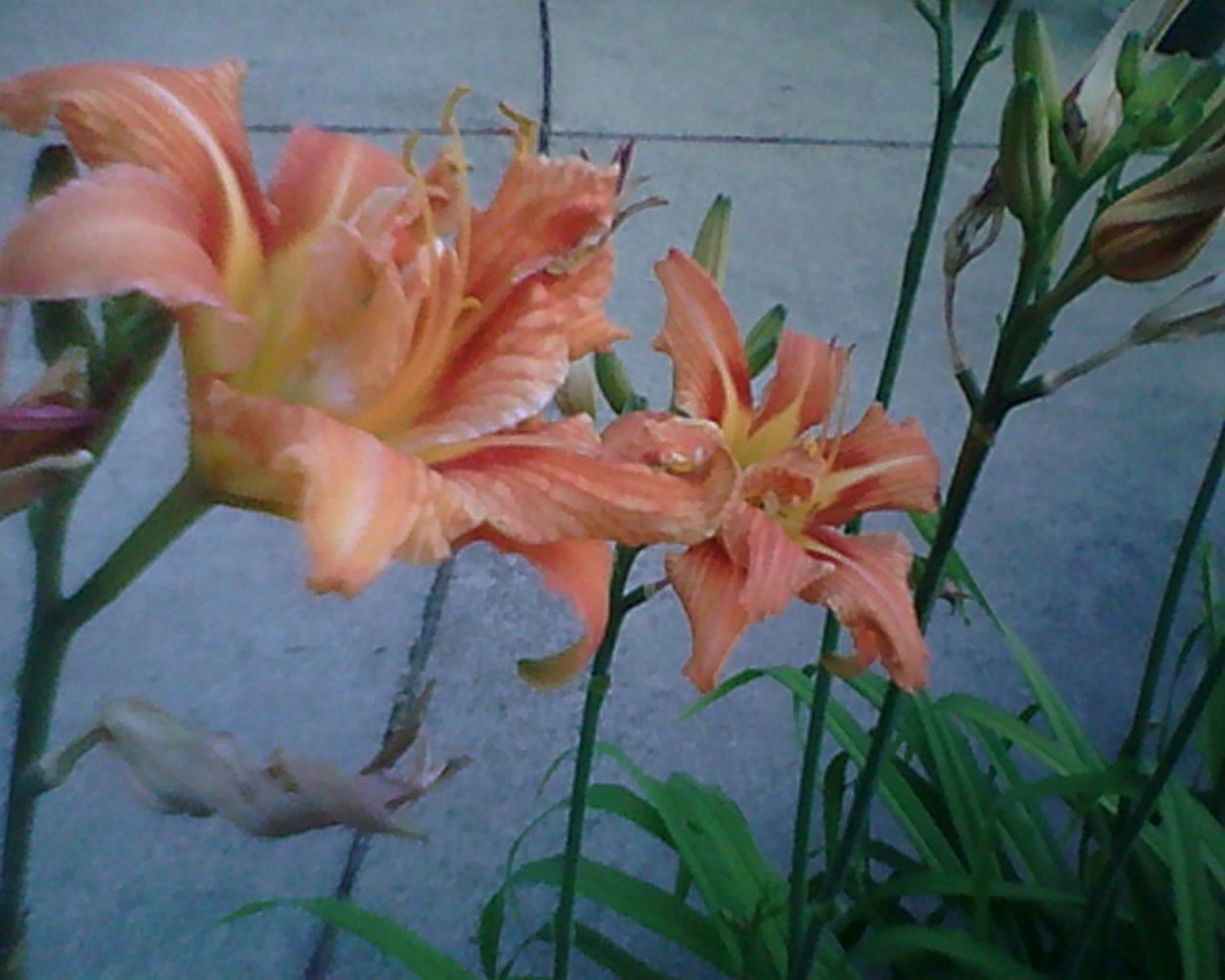
A cultivar of Hemerocallis fulva, not quite as invasive.
      Another of the early imported stoloniferous species daylily is Hemerocallis lilioasphodelus, or an old name, Hemerocallis flava. This species has also escaped into the wild. It is often called the Lemon Lily because it is scented like lemon. The blossom is light yellow and often stands of this species are seen in natural areas. It is not quite as invasive as H. fulva.


Hemerocallis lilioasphodelus, or Lemon Lily.

          The ease of growth and hybridization of daylilies has led to several daylily societies both in North America and elsewhere in the world. England was early responsible for hybridization success. Most hybridization has been done in the last 100 years. H. fulva is a diploid plant. That means that it has two copies of its DNA. But hybrids often have triploid and even tetraploid DNA. That means they have three or 4 copies of each chromosome. This makes hybridization easier. As I mentioned there are about 60,000 registered cultivars of Hemerocallis but there are probably just as many that have been developed but not registered. I discovered that if you go to any of the online purchase websites there are often lots of daylily roots for sale which contain plants that either have lost their names or have never received a registered name. When purchasing new daylilies, it is wise to keep the plants labeled in the garden. That way if the owner ever decides to distribute his daylilies for profit or decides to either show them in competitions or in anyway hybridize them, the name tag of the cultivar is known.

I brought this red cultivar from my old home. I don't recall the name, but it
had the word Christmas in its title. Its flowers are 5 inches across.
 
          The Hemerocallis Society has defined blossom size quantitatively. The above red flowered cultivar has blossoms that would be defined as large, greater than 4 1/2 inches. Small flowered varieties have flowers between 3 and 4 1/2 inches. Much prized miniature cultivars have flowers that are less than 3 inches in diameter. I have a cultivar pictured below that has flowers that are about 3 inches in diameter. Otherwise the colors are almost identical to that large flowered variety pictured above. One can notice that the miniature flowers have more of a triangular shape. This leads us to another characteristic that is used to classify cultivars -- flower shape.
 
 
    Flower shape is determined by the number and shape of the various petals and whether they are recurved or not.   Every daylily blossom has several parts. Usually there are 3 petals and 3 sepals alternating around the central throat. Either the petals or the sepals or both can be recurved that is bending backwards. If all 6 of these flower parts are of similar size, the flower will appear round. If only the petals or only the sepals are smaller or if one set is recurved, the flower will appear triangular. The petals and sepals can be quite narrow in which case the flower is often called a spider form. Or these parts can be equally wide giving a broad flat base for the color. Often the throat is a different color than the petals and sepals. Usually the throat is of medium depth but occasionally the throat is so deep that the flower resembles an Asiatic lily.  Sometimes between the petals and sepals and the throat is another band of color giving rise to so called banded or eyed forms. Some of the more modern and expensive daylily cultivars have diamond dusting which gives a sparkly nature to the petals or sepals.


This flower is rounded and therefore has no recurving. It does have an eye of
darker rose color. And the edges of the flower are ruffled.

     It is often said that Hermerocallis lacks only two colors of blossom -- true blue and pure white. Paging through the photos of daylilies in the above website, there are colors in daylilies that approach blue. Sometimes the blue is only in the center of the blossom. But indeed there are no daylilies yet which have the blue characteristic of the chicory blossom that you see blooming along the roadsides throughout North America. This would be my definition of a "true blue." As for white, daylily blossoms of some cultivars approach white through a very very light yellow, or green, or through a very light melon or peach. I am sure that hybridizers are working on a pure white cultivar.
Here is my "white". It is really just the palest of yellows.


       The following 3 photos are of a very prolific bloomer. I don't know its name but it is a likely cultivar of H. flava. I brought this variety from our old house. The color is an orange yellow with a same color throat. A drawback is that the color tends to fade even during the one day that it is open.


Here you can see the fading and likewise below.


Here the petals and sepals are equal and rather narrow. This gives the flower
a spider-like form.
      Daylily flowers can be single like most shown on this page, or they can be double as shown here, or even triple. In some cases only the petals or only the sepals are doubled, and then the flower is called polymorphous.

A partially double cultivar of H. fulva.


A unnamed cultivar which I brought from my old house. The sepals are
fairly plain, while the petals have more rose color and a central rib of yellow.

 
     Well, you now know more than you ever wanted to know about daylilies. Add just a few nuances and you could apply to be a master member of the American Hemerocallis Society. Better yet, just plant a few daylilies and enjoy their remarkable ability to proliferate quickly and brighten the entire perennial border. 
 
My stand of H. fulva with Lake Michigan in the background.


Wednesday, July 17, 2013

Scrabbling Over Scrabble

     Click on the following link to read about some new news in Scrabble playing. See my post of April 17, 2013.
  
http://www.nytimes.com/2013/07/14/opinion/sunday/scrabbling-over-scrabble.html?pagewanted=all&_r=0

    When I first saw this article I thought someone had stolen my idea. See my post of April 17, 2013. But this is some new news. The National Scrabble Association which has at least partially been supported by Hasbro, the toy company which currently manufactures Scrabble, the Board Game, is closing its doors.  Slowly over the years this article says, Hasbro has been withdrawing financial support. Finally as of July 1, the company has withdrawn all support and the Association has closed. This withdraws financial support for many of the competitive venues of the game.
     This occurs at a time when Scrabble is never more popular, and the competitive side of the game is at its broadest. Fatsis' article says that "more than a million people, from kids to hipsters to nonagenarians play daily on Facebook. In May, nearly 200 students in fourth through eighth grades competed in the National School Scrabble Championship. On Saturday, more than 500 die-hards,, the author included, gathered in Las Vegas for the National Scrabble Championship, a five-day 31-gme anagrammatic marathon."
      Indeed, Hasbro has spent millions of dollars in the last 25 years financing the NSA, organizing national, world, and school tournaments, booking the winners of some of these on late night TV spots, maintained a database of competitive players, published a newsletter, put the game on ESPN for 6 years, published a Scrabble dictionary and has kept it up to date with modern words that have become acceptable Scrabble words. Now Hasbro follows in the steps of its predecessor in Scrabble, Selchow and Richter who made Scrabble from its inception in 1948 until Hasbro purchased North American rights in 1989. In 1985, a marketing executive from Selchow and Richter said, " You have to understand, we are in the game-making business. We are not in the altruism business." Now Hasbro follows in these footsteps.
     I had no idea that the competitive arm of Scrabble play was so widespread and so active. I know that tournaments are very closely monitored. Tournament play is the real game of Scrabble, where players are not allowed to use aids, 2 word dictionaries, and other modern electronic gizmos. Also each play is timed and each player has only 25 minutes to complete all of his plays. This means that competitive players have to have at their disposal "178,000, 2 to 15 letter words" and they exercise their "spatial relations, board geometry and language maximization" skills repeatedly through several days of tournaments.
     Somehow the players and their associations will continue to support these venues. Competitive players have now formed their own independent North American Scrabble Players Association which is supported by higher dues and various forms of fundraising. This new organization will provide the $10.000 prize money for the national tournament in Vegas, replacing the $15,000 that Hasbro has withdrawn.  These tournaments will go on, but this article expresses the disappointment that industry can not find the wherewithal to provide support for such an honorable purpose.
     The author of this article in the New York Times, Stefan Fatsis, is a competitive scrabble player himself. He has written several books on Scrabble. The most recent is entitled: Word Freak: Heartbreak, Triumph, Genius and Obsession in the World of Competitive Scrabble Players.


Sunday, July 14, 2013

The Whip poor will and Tarrytown, NY.

The Whip Poor Will -- A Rare Bird!

     A couple weeks ago I was out in my Wild Area (my husband calls it my jungle) where I have a lot of prairie plantings, and I heard the call of a Whip Poor Will. I have only heard this bird call twice before. The first time was during an at dusk neighborhood walk in our old Applewood neighborhood. The second time was shortly after we moved to our new neighborhood in Mequon. I was again taking a walk and heard this bird call. This third time the call was coming from about 3 lots north of us, perhaps even from Virmond Park. All three times have been during migration. Click on the link below to hear the Whip poor will's call.

http://www.youtube.com/watch?v=MTATW8H8zpQ

     The Whip-poor-will is a member of our North American nightjar family (named after the nightjarring call after dark) as is the common night hawk, the paurauque of southern Texas,  the Chuck-will's-widow of Southeastern US, and the poorwill of Western canyons. These birds are all members of a genus of birds known as the Goatsuckers. They get this name because it was thought they would suck the milk of a female goat at night to nourish themselves. They were certainly seen around herds of goats and other animals at dusk, but only because they were chasing the insects around these animals.

      The night hawk is much more commonly seen as it flies in the sky in the late day and during dusk and gives its peent call. I recall studying for finals at my desk at the window in the northeastern corner of Currier Residence Hall at the University of Iowa in June and hearing that peent as the nighthawks take off in their nightly search for insects just as the street lights come on. They basically just fly with wide open mouths and scoop up the bugs in their swarms.  White wing bars which run across the wing identify the night hawk easily in its flight and also during its brief migration in late summer.  The migration of nighthawks can be an impressive event if you know when and where to look. These birds migrate in late summer, usually between August 10 and September 15th. But the majority will fly around August 26th or within 2 days either side of this date. A few may fly south during the day, but the vast majority do so within 2 hours of the sunset. Find an open field or open space, even such as Millennium Park in Chicago and scan the sky on those few nights. You might be lucky to witness the silent show that is going on overhead above tree level. These flights will detour and flutter around to catch insects in the swarms that they run into on this migration. This stuttered and fluttering flight led people to think these birds were bats, hence another common name, the bull bats.

    The whip-poor-will is much harder to see. It also is a nocturnal bird, but mostly flies from a perch only at dusk and at pre-dawn to catch insects with its wide jawed cavernous mouth. During the day and some of the night it simply perches on a branch or on the ground where its colorings make it next to invisible. When breeding it makes a nest among the leaves of the forest and will sit still on the nest, invisible, almost until stepped upon. But in contrast, its call is very noticeable and carries for long distances. It may repeat the call in rapid succession for an hour or more at dusk and at dawn.

     The Whip-poor-will nests on the ground, usually lays 2 eggs only and both parents help to raise the hatch lings. Because the bird is so hard to see and watch, not as much is known about its behavior as other more visible birds.

     This Whip-poor-will species has recently been divided into two separate species. The one I heard is now called the Eastern Whip-poor-will. The range for this bird is throughout southern and eastern Canada and much of the eastern United States. It winters in southern Florida and across the US Gulf Coast. It is rare locally throughout its range, but is not really threatened because of its vast range. I think the birds that I have heard on all three occasions were probably in migration only. I do not think they nest around southeastern Wisconsin or even northern Illinois. The second species' range is in southern California and northwestern Mexico. It has been separated from the Eastern species for so long that it has developed different markings and its call is a little different. These are the reasons that it was decided to name them a separate species. Even their DNA varies a little. That bird is called the Mexican Whip-poor-will.

     Here is a photo of the bird. I did not take this photo and I have never seen the bird myself, only hearing it on those three occasions.

                                                           The Eastern Whip-poor-will

     Early American Indian legends have often associated the haunting repetitive call with death. One New England folk legend says that the whip-poor-will can sense a soul departing and can also capture it as it flies. It is quite interesting that I heard this bird calling the night before I went to attend a funeral for the first member of our high school class to die in maturity. Of course, this is just a coincidence but it would be quite easy to attach a significance to this event as our ancestors often did.

    Because that call for which the bird is named is so notable, the bird's name or its call has appeared in many literary works and in many songs over the centuries. H.P. Lovecraft used the soul capturing idea as a plot device in his story,  The Dunwich Horror. Howard Phillips Lovecraft lived between 1890 and 1937 and wrote initially poetry, and later horror, fantasy and science fiction. He is especially known for a subgenre of writing called weird fiction. He said he was guided by a philosophical principle that he termed "cosmicism" or "cosmic horror" which he said is the idea that life is incomprehensible to human minds and indeed that the universe is basically an enemy to the interests of humanity. He conceived of a story cycle called the Cthulhu Mythos and invented a fictional magical textbook of rites and forbidden lore, called the Necrononmicon, which appears in the story The Dunwich Horror along with many whip poor wills.  Many of his stories were in the vein of Edgar Allan Poe, but perhaps even more horrific, if The Dunwich Horror is any indication. Stephen King was a great fan of Lovecraft and no doubt Lovecraft had a great influence on this well known and prolific writer. Mr. King called Lovecraft "the twentieth century's greatest practitioner of the classic horror tale"  In King's autobiographical book "Danse Macabre" he credited Lovecraft with his own fascination with the macabre . Lovecraft's stories have been made into plays, films and games. The Dunwich Horror was made into a B-movie in 1970. The story was altered significantly but it is based on a similar idea. It was actor Ed Begley's last role where he played Professor Henry Armitage, of the fictional Arkham, MA Miskatonic University. These places enter into several of Lovecraft's writing. The leading role of Wilbur Whateley was offered to Peter Fonda who turned it down. Dean Stockwell finally played the role of Wilbur Whateley. The film was shot in Mendocino, California.

     Below is an online copy of this short story written in 1928 .  Note that several recurring themes of Lovecraft's appear in this story. He frequently used the fictional town of Arkham, Massacusetts and this town's fictional Miskatonic Universtiy. Also Lovecraft's fictional magical text, the Necronomicon appears and plays a large role in the story. One of his invented deities, Cthulhu is sited. You might be interested in reading this story.

http://www.hplovecraft.com/writings/texts/fiction/dh.aspx

    Perhaps the most famous reference to the  whip poor will is in Washington Irving's The Legend of Sleepy Hollow. In Irving's description of the local school teacher, Ichabod Crane, and the general haunting nature of the locale, which led to that horrible legend of the Hessian headless horseman of all of our memories, the whip poor will is mentioned along with other strange night sounds and visions.
     "He was, in fact, an odd mixture of small shrewdness and simple credulity. His appetite for the marvelous, and his powers of digesting it, were equally extraordinary; and both had been increased by his residence in this spell-bound region. No tale was too gross or monstrous for his capacious swallow. It was often his delight, after his school was dismissed in the afternoon, to stretch himself on the rich bed of clover bordering the little brook that whimpered by his schoolhouse, and there con over old Mather's direful tales, until the gathering dusk of evening made the printed page a mere mist before his eyes. Then, as he wended his way by swamp and stream and awful woodland, to the farmhouse where he happened to be quartered, every sound of nature, at that witching hour, fluttered his excited imagination, -- the moan of the whip poor will from the hillside, the boding cry of the tree toad, that harbinger of storm, the dreary hooting of the screech owl, or the sudden rustling in the thicket of birds frightened from their roost. The fireflies, too, which sparkled most vividly in the darkest places, now and then startled him, as one of uncommon brightness would stream across his path; and if, by chance, a huge blockhead of a beetle came winging his blundering flight against him, the poor varlet was ready to give up the ghost, with the idea that he was struck with a witch's token. His only resource on such occasions, either to drown thought or drive away evil spirits, was to sing psalm tunes and the good people of Sleepy Hollow, as they sat by their doors of an evening, were often filled with awe at hearing his nasal melody, 'in linked sweetness long drawn out,' floating from the distant hill, or along the dusky road."

     If this brief paragraph strikes your memories from the distant past, since I am sure this story was required reading for many of you way back in high school, or perhaps even grade school -- then here is a link to the entire story.

http://www.bartleby.com/310/2/2.html

  Or if you would rather arouse another memory from your childhood, here is the link to the Disney short cartoon feature of The Legend of Sleepy Hollow. Much of the story here is read by Bing Crosby, and their are songs as well, along with the animated views. It's really cool.

http://www.youtube.com/watch?v=dxX66vLSZoQ

Tarrytown in 1928, looking south toward Manhattan.
     As depicted in The Legend of Sleepy Hollow, the area of Tarrytown, NY and the small village which the modern city engulfed, Sleepy Hollow, are very historic and scenic places. We had the pleasant occasion just in May this year to attend my niece's wedding held at Tappan Hill Mansion in Tarrytown, NY. If you read the first paragraph of The Legend of Sleepy Hollow, you heard this area referenced. The Dutch people who settled this area grew wheat. Tarrytown was their market town and was called Terve Town (Terve, meaning wheat in Dutch). Apparently the name was corrupted to Tarrytown. However, Washington Irving has a different explanation of the city name. It was thought that Tarrytown received its name because the husbands of the local Dutch folk, often tarried too long at the local tavern. And nearby is the small village still known as Sleepy Hollow. It is a very nice area to visit, but you do have to plan ahead. At the turn of the century and into the early 1900s, Tarrytown became known as "The Millionaire's Colony." At that time, there were 65 huge and opulent mansions in this area, many of them overlooking the Hudson River. There are visits that can be made to several of these local mansions along the Hudson River, that once belonged to the local blue bloods. And since many of these mansions have become financially and otherwise burdensome for the descendant owners of these properties, several have become resorts, hotels and wedding venues. Such is Tappan Hill Mansion where the wedding was held. It once belonged to Mark Twain who lived here from 1900 to 1902.

The Hudson River from Tappan Hill Mansion.

 
View directly from the Wedding Room.
Since there are no rooms at Tappan Hill, we stayed at Tarrytown Estate Hotel,
originally another of these opulent mansions in the area.
Where the wedding would take place(it was raining.)

 
The wedded couple leaves the reception at Tappan Hill Mansion.
   
      The rehearsal dinner was held in downtown Yonkers, at X2O Xaviars on the Hudaon, down the Hudson River about 12 miles from Tarrytown. From this venue, you can see the Tappan Zee Bridge to the north and the George Washington Bridge to the south, along with the skyscrapers of Manhattan.

George Washington Bridge and Manhattan to the left, Fort Lee, NJ to the right.


Just to the left of bridge tower, note Freedom Tower in lower Manhattan.
Tappan Zee Bridge, Tarrytown, NY

 In Tarrytown, if you intend to visit some of these historic mansions, you will need to buy a single ticket sold at several places in the city. Often these need to be purchased or reserved in advance. The timing of the visits to the different sites require this. Therefore, you can not just show up and expect to get tickets to all the places you want to see. The various sites include Kykuit, Rockefeller's mansion in Tarrytown, built in 1902; Lyndhurst Mansion which belonged to Jay Gould the railroad magnate; Sunnyside which was a home and property created and owned by Washingtion Irving himself; and the Sleepy Hollow area which has a restored mill and river walk, a museum demonstrating the history of the area, and finally the Cemetery of Sleepy Hollow. Otherwise places that are described in The Legend of Sleepy Hollow do not exist. Still you can certainly get the flavor of this story by visiting the area and seeing some of these sites.

Sunnyside, Washington Irving's estate in Tarrytown, NY.
Kykuit, the Rockefeller mansion built in 1902.
Lyndhurst Mansion, site of a neat Halloween lighted tour


     .
     May I make one more related suggestion, should you decide to travel to this historic area. Go at Halloween time. In early and mid October, the leaves will be at peak along the Hudson. And the area of Tarrytown and Sleepy Hollow hold all sorts of wonderful haunted tours and light shows. There is a lantern light tour of Sleepy Hollow Cemetery. Many of these special tours start well before Halloween. We were there in May but were I ever to go back, I would go at Halloween time -- Yes, I would!  Woooo!