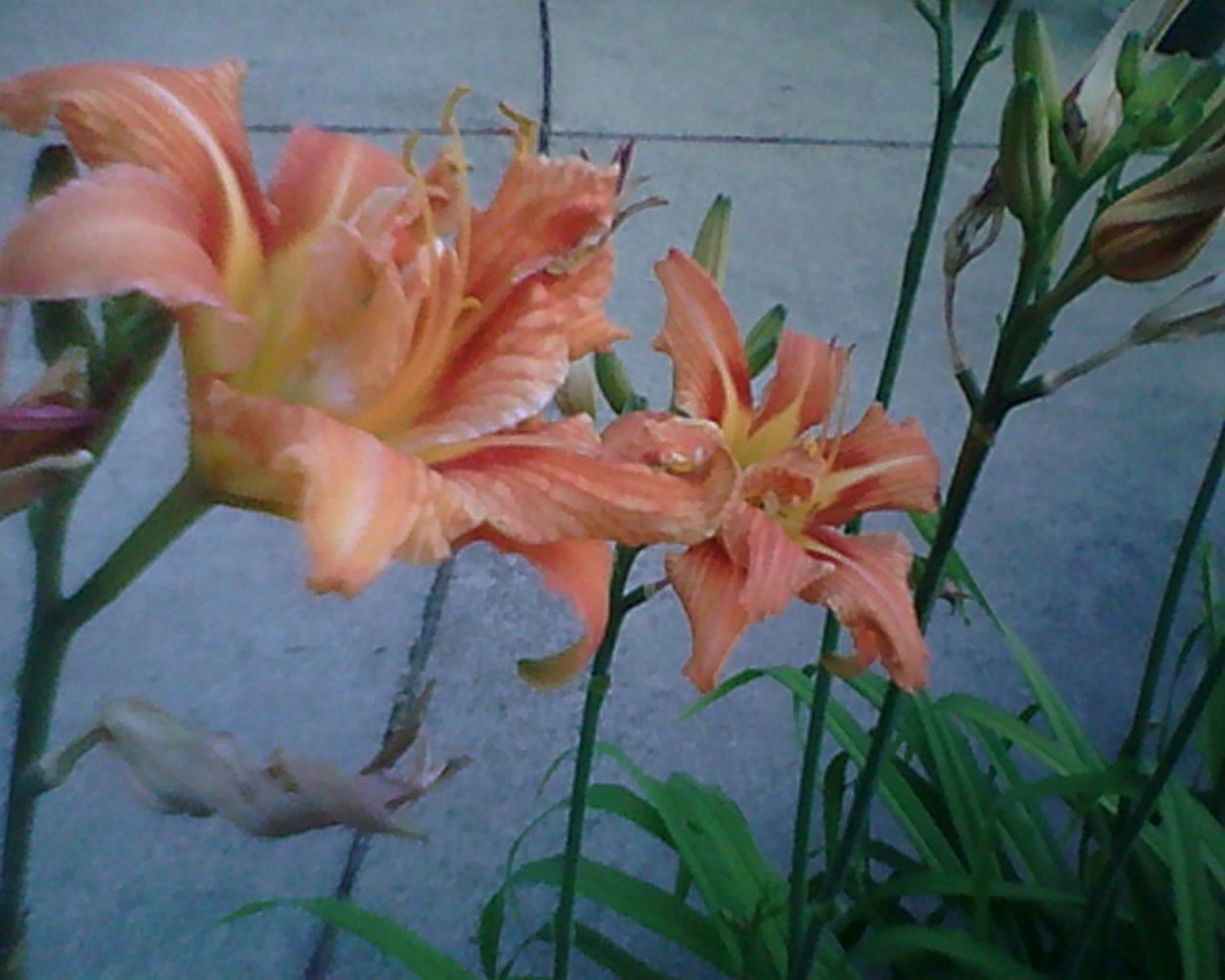
Did the title arouse your interest? Most people will not recognize this proper name. Many people will not even know that the name refers to a plant. And certainly the vast majority of my readers will not recognize this name as the species name of a very common and recognizable perennial flower.
Hemerocallis is the species name for daylily. This name derives from the Greek words: hemera which means day and kalos which means beautiful.
Daylilies are native to Eurasia and now are seen throughout the world. In the United States they are a backbone flower in the perennial border. They will grow and prosper in any well drained soil in an area with full sun to light shade. They are resistant to most pests and diseases and even can survive some drought when well established. They come in every color except true blue. Each flower lasts only a day -- hence their common name, but the bracket of buds provide flowers over a 2 to 4 weeks period of time. Different varieties bloom at different times starting in July (in Wisconsin), so that a combination of varieties in the border will provide bloom for the entire rest of the summer. The complexity of the blooms varies from small single petaled flowers to double and even triple flowers, as well as spidery blooms to frilly ruffled complex blooms with petals edged in different colors.
The following website has a wonderful listing of variety names with photos. There are indeed over 60,000 named and licensed cultivars of the 18 named species. Check out the website. You can see from this encyclopedic photo gallery that there is a daylily cultivar that would fit almost any garden need, no matter the color, size of bloom, height of plant or soil and climate requirements
http://www.ofts.com/photo/dl_view.html
In my garden, last year was the year of the iris. And this year seems to be the year of the daylily. All my groupings are topped with profuse bloom, indeed more blossoms than I have ever seen. I tried to recall if I had remembered to scatter some timed release fertilizer pellets among the daylilies last year. Is that why they are so beautiful this year. But then one of my water aerobic class friends noted that her daylilies were going wild this year as well. so there was something about the climate and weather that has led to this. I read that if you cut off the dead blossoms and don't let seed pods form, you might get more flowers the next year. So I wonder if the drought we had last year interfered with seed production prompting a more profuse flowering this year. Just a theory!
I commented about the lack of pests that affect daylilies but there is one pest that can be very destructive. That is the whitetailed deer. Deer eat the very young tender plants as they are emerging in the spring. Aside from the temporary raggety appearance that this produces it does not significantly affect the years growth or flowering. Once the growth becomes firmer, the deer are no longer interested in a snack. But then when the flower buds are enlarging there comes another deer risk. Sometimes I think the deer are walking by every night checking out the size of the buds. And just as the largest one is about to open up, the daylily grower can come outside of a morning and the tops have all been nibbled off ending that seasons of flowers. Therefore, I have learned exactly when to use my deer repellent spray du jour. I spray the enlarging buds once a week for 2 to 3 weeks and the deer seem to get the idea. You have to remember that deer are creatures of habit. If you can break that habit of the walk by of your daylily beds, you can protect them and a few interrupted sprays will usually do this.
 |
| A prolific stand of Hemerocallis fulva, the Tawny Daylily |
 |
| A single Tawny Daylily bloom. |
In the 17th century, the first English colonists to North America brought the Tawny Daylily, species Hemerocallis fulva to American gardens. These daylilies escaped from gardens and are now seen growing along roadsides and in many sunny areas. This characteristic has resulted in a plethora of common names for the perennial -- such as roadside lily, ditch lily, railroad lily, washhouse lily and outhouse lily. These hardy spreading types were often planted to mask the outhouse, hence this name. It has also been called Tiger Lily but it is not a lily at all, but an entirely unrelated family of plants. This species is so prevalent that many people think it is a native North American wildflower, but that is not the case. This fulvous daylily is stoloniferous. This means it grows by underground runner. These original daylilies are therefore very invasive and can take over a garden from other desirable perennials. Due to its invasiveness, one probably should not plant these species daylily but they are often the ones that are shared among friends when it is time to divide the clump.
I have several stands of Tawny Daylily, because I found an old bed near the ranch house we tore down and replaced with our new house on Lake Michigan. Therefore I divided these clumps and populated my new empty beds with them around my house. In my growing conditions they have been only slightly invasive.
 |
| A cultivar of Hemerocallis fulva, not quite as invasive. |
Another of the early imported stoloniferous species daylily is Hemerocallis lilioasphodelus, or an old name, Hemerocallis flava. This species has also escaped into the wild. It is often called the Lemon Lily because it is scented like lemon. The blossom is light yellow and often stands of this species are seen in natural areas. It is not quite as invasive as H. fulva.
 |
| Hemerocallis lilioasphodelus, or Lemon Lily. |
The ease of growth and hybridization of daylilies has led to several daylily societies both in North America and elsewhere in the world. England was early responsible for hybridization success. Most hybridization has been done in the last 100 years. H. fulva is a diploid plant. That means that it has two copies of its DNA. But hybrids often have triploid and even tetraploid DNA. That means they have three or 4 copies of each chromosome. This makes hybridization easier. As I mentioned there are about 60,000 registered cultivars of Hemerocallis but there are probably just as many that have been developed but not registered. I discovered that if you go to any of the online purchase websites there are often lots of daylily roots for sale which contain plants that either have lost their names or have never received a registered name. When purchasing new daylilies, it is wise to keep the plants labeled in the garden. That way if the owner ever decides to distribute his daylilies for profit or decides to either show them in competitions or in anyway hybridize them, the name tag of the cultivar is known.
 |
I brought this red cultivar from my old home. I don't recall the name, but it
had the word Christmas in its title. Its flowers are 5 inches across.
|
The Hemerocallis Society has defined blossom size quantitatively. The above red flowered cultivar has blossoms that would be defined as large, greater than 4 1/2 inches. Small flowered varieties have flowers between 3 and 4 1/2 inches. Much prized miniature cultivars have flowers that are less than 3 inches in diameter. I have a cultivar pictured below that has flowers that are about 3 inches in diameter. Otherwise the colors are almost identical to that large flowered variety pictured above. One can notice that the miniature flowers have more of a triangular shape. This leads us to another characteristic that is used to classify cultivars -- flower shape.

Flower shape is determined by the number and shape of the various petals and whether they are recurved or not. Every daylily blossom has several parts. Usually there are 3 petals and 3 sepals alternating around the central throat. Either the petals or the sepals or both can be recurved that is bending backwards. If all 6 of these flower parts are of similar size, the flower will appear round. If only the petals or only the sepals are smaller or if one set is recurved, the flower will appear triangular. The petals and sepals can be quite narrow in which case the flower is often called a spider form. Or these parts can be equally wide giving a broad flat base for the color. Often the throat is a different color than the petals and sepals. Usually the throat is of medium depth but occasionally the throat is so deep that the flower resembles an Asiatic lily. Sometimes between the petals and sepals and the throat is another band of color giving rise to so called banded or eyed forms. Some of the more modern and expensive daylily cultivars have diamond dusting which gives a sparkly nature to the petals or sepals.

 |
This flower is rounded and therefore has no recurving. It does have an eye of
darker rose color. And the edges of the flower are ruffled. |
It is often said that Hermerocallis lacks only two colors of blossom -- true blue and pure white. Paging through the photos of daylilies in the above website, there are colors in daylilies that approach blue. Sometimes the blue is only in the center of the blossom. But indeed there are no daylilies yet which have the blue characteristic of the chicory blossom that you see blooming along the roadsides throughout North America. This would be my definition of a "true blue." As for white, daylily blossoms of some cultivars approach white through a very very light yellow, or green, or through a very light melon or peach. I am sure that hybridizers are working on a pure white cultivar.
 |
| Here is my "white". It is really just the palest of yellows. |
The following 3 photos are of a very prolific bloomer. I don't know its name but it is a likely cultivar of H. flava. I brought this variety from our old house. The color is an orange yellow with a same color throat. A drawback is that the color tends to fade even during the one day that it is open.
 |
| Here you can see the fading and likewise below. |
 |
Here the petals and sepals are equal and rather narrow. This gives the flower
a spider-like form. |
Daylily flowers can be single like most shown on this page, or they can be double as shown here, or even triple. In some cases only the petals or only the sepals are doubled, and then the flower is called polymorphous.
 |
| A partially double cultivar of H. fulva. |
 |
A unnamed cultivar which I brought from my old house. The sepals are
fairly plain, while the petals have more rose color and a central rib of yellow. |
Well, you now know more than you ever wanted to know about daylilies. Add just a few nuances and you could apply to be a master member of the American Hemerocallis Society. Better yet, just plant a few daylilies and enjoy their remarkable ability to proliferate quickly and brighten the entire perennial border.
 |
| My stand of H. fulva with Lake Michigan in the background. |
 In my gardening, I often let volunteers grow even in my formal beds near the house. I have been watching these asters as baby plants for a couple of years, growing in the middle of my entry way bed near the house. This year they had multiple stems so I decided to pinch them as one does with chrysanthemums hoping that they would stay shorter and provide more bushy growth. Well they still grew very tall, but they did produce many blooms. My spouse told me I should pull out these weeds during the summer, but I ignored him, as I usually do, and look what this native North American plant produced.

 I once saw flowering kale or ornamental cabbage (Brassica oleracea) planted in tiny (3 by 3 feet) cutouts in the sidewalks or around trees while walking the pavement in New York City in the fall. I loved the effect. Since then I have been purchasing these plants even in the spring when very small. I plant them along my front walkway. During the summer and depending on the coolness of the weather, some bolt to flower and seed, but this year with our coolness, several formed very nice colorful kale plants. If they do bolt, in the late summer I just cut off the flower stems and sometimes interesting shapes result. Even bolted plants will brighten their color in the leaves with the fall season. And look how the pink ones complement the color of the nearby aster plant. Sometimes during mild winters, some of these plants will survive the winter, especially the flowering kale varieties, and you will get some growth the next year. However, getting a nice circular colorful head like this for two years in a row is unlikely.
 Dahlias can be the star of the fall garden. I have them planted among other June flowering plants in my beds. They come into their own in August and last until frost, a time when the garden needs some of their showiness. They are heavy feeders and my neglect of my garden this summer showed as I didn't get as many blooms. But I love their variety of gorgeous colors. Most of mine are low growing, but I have one 3 foot tall white spider dahlia that I place in the middle of the bed. After frost, I dig up the tubers, air dry them a couple days, and then store them in a paper bag in my wine cellar. Yes, you read that right -- the wine cellar is cooled and humidified -- perfect for the dahlia tubers. I replant directly in the ground in the spring, as soon as I can work the ground. I add some sort of fertilizer to the soil when I plant in the spring -- either bagged manure, or pellet fertilizer, or bone meal or a mixture of these substances. This year I just did not add liquid foliage fertilizer sprinklers during the summer and I think the dahlia's suffered for this.
 For the first time in many years, this year I planted nasturtium seeds and sweet alyssum bedding plants in many tiny vacant spots along my walks in among my perennials. I am seeing the pleasant results now because both of these annuals planted in the ground are still going strong unlike those planted in my pots as you can see on the left. I used the variegated leaf form of the nasturtiums and really like the bright colors of yellow, orange, and dark reddish orange. Also in this photo in the foreground is the only foxglove plant that survived the past winter as a seedling. This whole area was filled with foxglove seedlings last fall. I covered them with lots of wood chips but all but one still succumbed.